Victor Horta and the Frison House in Brussels

Nupur Tron

 19,90

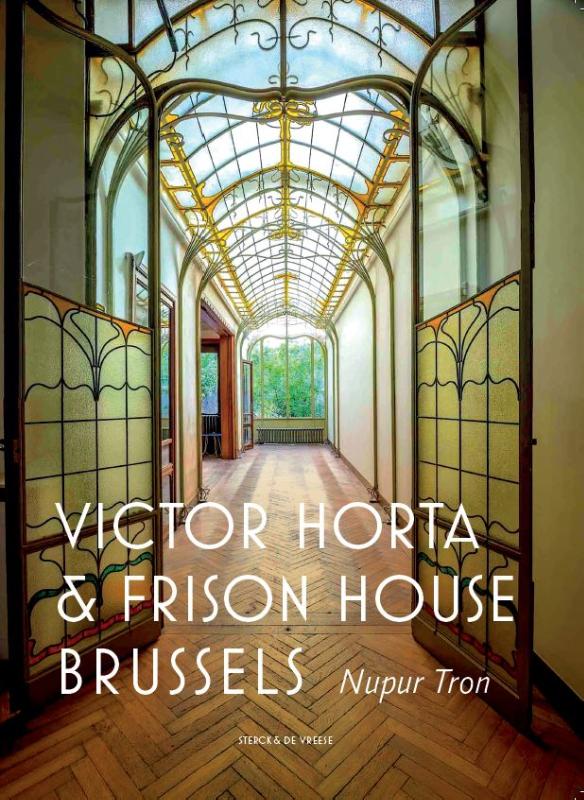
In the middle of the Lebeaustraat in Brussels, sandwiched between neo-Renaissance and neo-Gothic houses, stands an Art Nouveau jewel designed by Victor Horta: the Frison House. It was
commissioned by Maurice Frison, a lawyer and friend of the architect, and was built in 1894-1895. Horta designed not only the house, but also all its furniture and decoration, right down to the smallest detail: from door handles to marble fireplaces, from mosaic floors to elegant banisters, from wall lamps to the gratings for the cellar openings. The absolute eyecatcher is the winter garden, whose elegant design allows soft yellow light to flow subtly into its perfectly proportioned space.

Nupur Tron is the author of this book and owner of the house. In recent years, she has breathed new life back into Horta’s masterpiece. She pieced together bits of the old chandeliers she found in one of the cellars. She had items of furniture designed by Horta lovingly restored. With great passion, she continues to search for the funds that will allow her to restore the entire house to its former glory, one step at a time.

Horta and the Frison House in Brussels is an ode to the architect and his creation.

Nupur Tron is from India. She studied Design, Marketing & Merchandising and Fine Arts at the Fashion Institute of Technology in New York. She designs jewellery, in which the different styles of east and west meet in harmony.

Verschijningsvorm:
Paperback
Taal:
Engels
Uitgeverij:
Sterck & De Vreese
Aantal pagina's:
128
Druk:
1
Uitgiftedatum:
19-11-2019
Gewicht:
400 gram
Afmeting:
231x173x12 mm
ISBN:
9789056155445

Gerelateerde boeken

  • Cache-sexe

    Cache-sexe

    Covered, uncovered, discovered
    Philip van Kerrebroeck
     34,90

    Cache-sexe

    This book asks why humans through history have covered their genitals and worn a cache-sexe. Does the cache-sexe merely provide protection, or is it an instrument to draw attention? Can the cache-sexe be used to stimulate certain thoughts? Why does not wearing a cache-sexe provoke shame one society but not in another? Are nudity and nakedness the same?

    On his quest to answer these questions, the author takes the reader on a review of the anatomy of the female and male genitals and reflects on how this part of the human body has been perceived over time and in various cultures. The different types of male and female cache-sex are discussed with reference to comprehensive illustrations based on unique and sometimes previously unpublished examples of cache-sexes and photographic documentation. The book also pays attention to the covering of the ‘backside’. Following this 360° exploration of the use of the cache-sexe, the place of the cache-sexe in art and fashion is uncovered.

    Philip Van Kerrebroeck is an urologist and professor emeritus of Urology at the University of Maastricht. Born in Leuven (Belgium), he trained in Surgery and Urology in Brussels, Utrecht, Nijmegen and San Francisco. Over the years, he has also developed an interest in the history of urology and cultural anthropology. He is currently chairman of the History Office of the European Association of Urology (EAU).

     34,90
  • Meesteressen van het penseel

    Meesteressen van het penseel

    Vrouwelijke kunstenaars in de 17e eeuw
    Janneke Budding
     27,90
  • De vogel en de componist

    De vogel en de componist

    Vogelzang als inspiratiebron
    Fernand Rochette
     24,90

    De vogel en de componist

    Beethoven en zijn vriend Schindler stopten tijdens een wandeling bij een kabbelend beekje en Beethoven zei: ‘Hoor je de zang van de merel en de koekoek? … Hier heb ik twintig jaar geleden mijn Pastorale ontworpen. De vogels speelden en zongen in de takken. Ze hebben samen met mij gecomponeerd.’ Componisten uit alle eeuwen en streken lieten zich door
    vogelzang inspireren. Sommigen waren echte vogelaars of natuurliefhebbers, anderen hoorden dan weer een puttertje of een zanglijster in een volière zingen. Ze observeerden, luisterden en lieten daarna het gefluit van de vogels in de muziek weerklinken. De vogel en de componist introduceert de lezer eerst in de vogelzang: Waarom zingt een vogel? Waar kan je de vogel het best waarnemen? 40 verschillende vogels klinken in 160 composities van meer dan 60 componisten. Van Händel tot Vivaldi en Prokovjef, van Ravel tot André Rieu en Alban Berg. Elke zang van de vogel en elk muziekstuk waarin de vogel figureert, kan worden afgespeeld via een QR-code.

     24,90
  • De Duiven van Temminck en Knip

    De Duiven van Temminck en Knip

    Alexander Reeuwijk, Hay Wijnhoven
     35,00