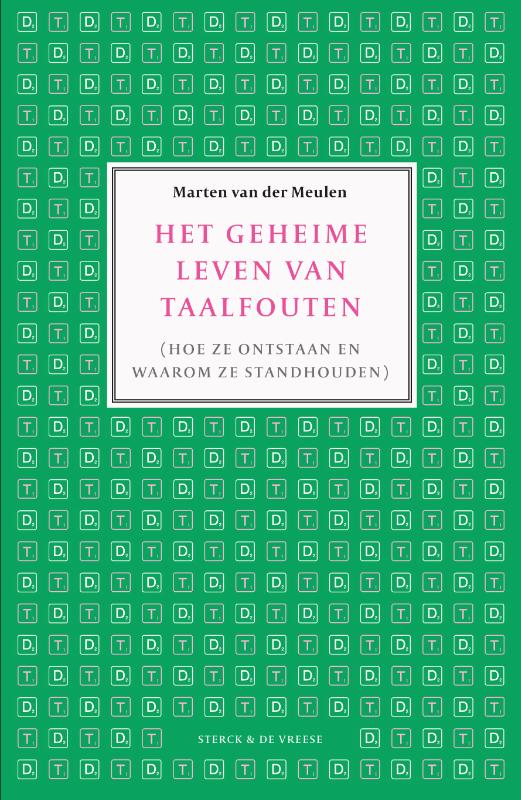
Het geheime leven van taalfouten
€ 27,90
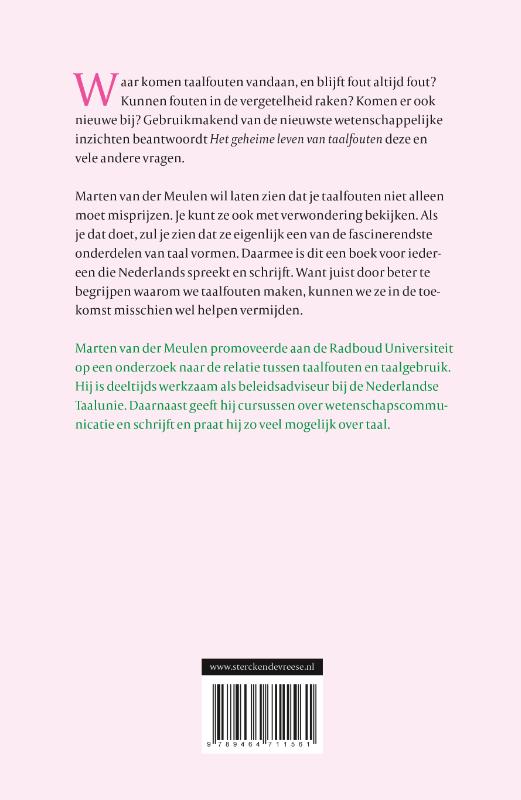
Waar komen taalfouten vandaan, en blijft fout altijd fout? Kunnen fouten in de vergetelheid raken? Komen er ook nieuwe bij? Gebruikmakend van de nieuwste wetenschappelijke inzichten beantwoordt Het geheime leven van taalfouten deze en vele andere vragen.
Marten van der Meulen wil laten zien dat je taalfouten niet alleen moet misprijzen. Je kunt ze ook met verwondering bekijken. Als je dat doet, zul je zien dat ze eigenlijk een van de fascinerendste onderdelen van taal vormen. Daarmee is dit een boek voor iedereen die Nederlands spreekt en schrijft. Want juist door beter te begrijpen waarom we taalfouten maken, kunnen we ze in de toekomst misschien wel helpen vermijden.
Marten van der Meulen promoveerde aan de Radboud Universiteit op een onderzoek naar de relatie tussen taalfouten en taalgebruik. Hij is deeltijds werkzaam als beleidsadviseur bij de Nederlandse Taalunie. Daarnaast geeft hij cursussen over wetenschapscommunicatie en schrijft en praat hij zo veel mogelijk over taal.
Gerelateerde boeken
-
Introduction to Dutch Low Saxon Language and Literature
€ 26,50In 2018, Dutch Low Saxon received national recognition as a full-fledged language in its own right.
In “Introduction to Dutch Low Saxon”, five experts offer a concise yet multifaceted description of Gronings, Drents, Stellingwerfs, Sallands, Twents, Achterhoeks, and Veluws.
The authors cover the sounds, word forms, syntactic characteristics, as well as large-scale dictionary projects. In addition, ample attention is paid to the position the language occupies in society, and to the command and usage of Dutch Low Saxon.
The development of knowledge about Dutch Low Saxon, encouragement to use it, and also preservation of the language are matters that mainly take place in the various regions. This book offers plenty of information on these aspects, and also on the institutes and organisations that deal with Dutch Low Saxon.
Dutch Low Saxon literature is clearly presented on the basis of periods and regions, and the list of sources invites the reader to further delve into the wonders of this centuries-old language.“Introduction to Dutch Low Saxon” is aimed at people with a general interest in regional languages. This book allows students of Dutch, German and Frisian to raise their knowledge to a higher level. This book may also serve to supplement the knowledge of Dutch Low Saxon of people who work at (regional) language institutes.
-
Buurtaal
€ 24,90In Nederland en Vlaanderen spreken we dezelfde taal. Althans, dat denken we. Hoewel we veel ‘Nederlands’ delen, zijn beide ‘Nederlandsen’ niet helemaal identiek. Die grote verschillen en nuances in uitspraak en woordenschat zorgen voor hilariteit, ergernis, discussies en soms misverstanden en onbegrip. Betekent ‘Wat een enerverende dag’ wel hetzelfde in
Nederland en Vlaanderen? In welke volgorde kun je de werkwoorden ‘moeten’, ‘hebben’ en ‘gedaan’ op het einde van een bijzin plaatsen? Kun je spreektalige woorden als het Vlaamse ‘goesting’ en het Nederlandse ‘optyfen’ wel in geschreven teksten gebruiken? Hoe Vlaams mag je tekst zijn voor een Nederlands publiek en omgekeerd, hoe Nederlands voor Vlaamse lezers? En bestaat een neutrale Nederlandse tekst voor het hele taalgebied wel? In dit boek staan het Belgisch- en Nederlands-Nederlands broederlijk naast elkaar. Met aandacht voor de historische achtergrond van de taalontwikkeling en
de cultuurverschillen tussen Nederland en Vlaanderen. Met vele rake voorbeelden en handige lijstjes voor onmiddellijk gebruik.Miet Ooms is vertaler, variatielinguïst en taalliefhebber pur sang. Op haar website taalverhalen.be vertelt ze met veel liefde en verwondering over taalvariatie in het Nederlands.
-

Humanity is Not a Plague
€ 19,90In ‘Humanity is Not a Plague’, Cees Buisman argues that it is possible for 10 billion people to exist together on this Earth – as predicted for the year 2100 – provided that the richer part of the world no longer merely focuses on its own health, prosperity and happiness, and instead starts working seriously on developing a higher consciousness.
In this essay, Buisman sharply analyzes some of the problems facing mankind, such as fresh water shortages, whilst overturning several clichés and offering unexpected, positive solutions. Overpopulation is not the problem; the effects of our actions on the rest of the world have a much greater impact. ‘Back to nature’ is not the solution, nor is an overreliance on science and innovation. Large-scale technologies could even increase our problems. It seems that the growth of humanity will depend on the growth of our consciousness.
Cees Buisman studied water purification engineering, in addition to business administration, communication theory and applied integral psychology. Throughout his life he has worked on new environmental technologies, which are used in industry all over the world. His scientific work is highly cited. Buisman is the Director of Wetsus – European Center for Sustainable Water Technology, and Professor at Wageningen University, in the Netherlands.
-